
 Terra Sanchez

When people talk about basketball greatness, the conversation almost always turns toward scoring—Jordan’s fadeaway, Kobe’s killer instinct, LeBron’s power drives. But there’s a rare kind of greatness that doesn’t rely on putting the ball through the hoop. It’s built on grit, timing, sacrifice, and obsession. No player embodied that form of greatness better than Dennis Rodman, the man who turned rebounding and defense into an art form.
Rodman’s career wasn’t about points; it was about impact. He didn’t just play defense—he disrupted it. He didn’t just grab rebounds—he devoured them. What made him extraordinary wasn’t athleticism alone, but a mind wired to understand every subtle angle of the game. He made effort glamorous, and he turned chaos into control.

The Early Spark That Shaped The Worm
Dennis Rodman’s journey to NBA immortality didn’t follow the path of prodigies. He wasn’t a highly touted high school phenom or a college sensation. He was a late bloomer who discovered his purpose through struggle. After growing up in a turbulent household in Dallas, Rodman drifted through odd jobs before a growth spurt and a chance opportunity at Southeastern Oklahoma State University changed everything.
There, his work ethic became legend. Rodman wasn’t the most skilled shooter or ball handler, but he attacked every rebound and defensive possession with reckless hunger. Scouts noticed his boundless energy and his uncanny knack for predicting where the ball would land. By the time the Detroit Pistons drafted him in 1986, Rodman had found the one thing he was born to do—compete harder than anyone else.
The Detroit Years: Forged in the Fire of the “Bad Boys”
Rodman’s time with the Pistons turned him from a raw athlete into a defensive weapon. Detroit in the late 1980s was a war zone on hardwood. The “Bad Boys” earned their nickname with bruising, physical basketball that tested the league’s toughness. Rodman fit right in. Under coach Chuck Daly, he learned how to channel his chaos into structure, transforming into a key piece of Detroit’s defensive core.
While teammates like Isiah Thomas and Joe Dumars led the scoring, Rodman became the emotional engine. He hounded opponents with relentless energy, diving for loose balls, switching seamlessly on defense, and grabbing rebounds that defied logic. The Pistons won back-to-back championships in 1989 and 1990, and Rodman’s defensive dominance was recognized with two NBA Defensive Player of the Year awards.
In those years, Rodman’s rebounding numbers began to climb toward historic levels. But beyond stats, what set him apart was effort that bordered on obsession. He studied how every shot bounced off the rim, memorizing angles and spin. He analyzed the tendencies of shooters—where Larry Bird’s jumpers tended to ricochet, how Michael Jordan’s misses spun differently. He turned rebounding into a science long before analytics became part of basketball language.
Mastering the Geometry of the Glass
Rodman once said, “I’d sit there and react to the ball. It’s like a dance.” That dance became his signature. He didn’t rely solely on height or brute strength; instead, he combined impeccable timing with intuition. Standing at 6’7″, he wasn’t the biggest rebounder on the court, but he was always in the right place.
He tracked the trajectory of every shot, predicting where it would fall before others even jumped. He used his body like a spring, bouncing twice while others leapt once. He tipped the ball to himself when boxed out. And when the ball seemed out of reach, he’d twist, contort, or dive across the floor just to get a fingertip on it.
During his prime, Rodman averaged over 18 rebounds per game, a feat unimaginable in the modern NBA. He led the league in rebounding seven consecutive seasons, dominating bigger players through intelligence and tenacity.
To Rodman, rebounding wasn’t about luck—it was an equation of anticipation, physics, and will. Each rebound told a story of positioning and persistence. Watching him rebound was like witnessing an artist at work—every motion deliberate, every outcome explosive.
Defense as Performance Art
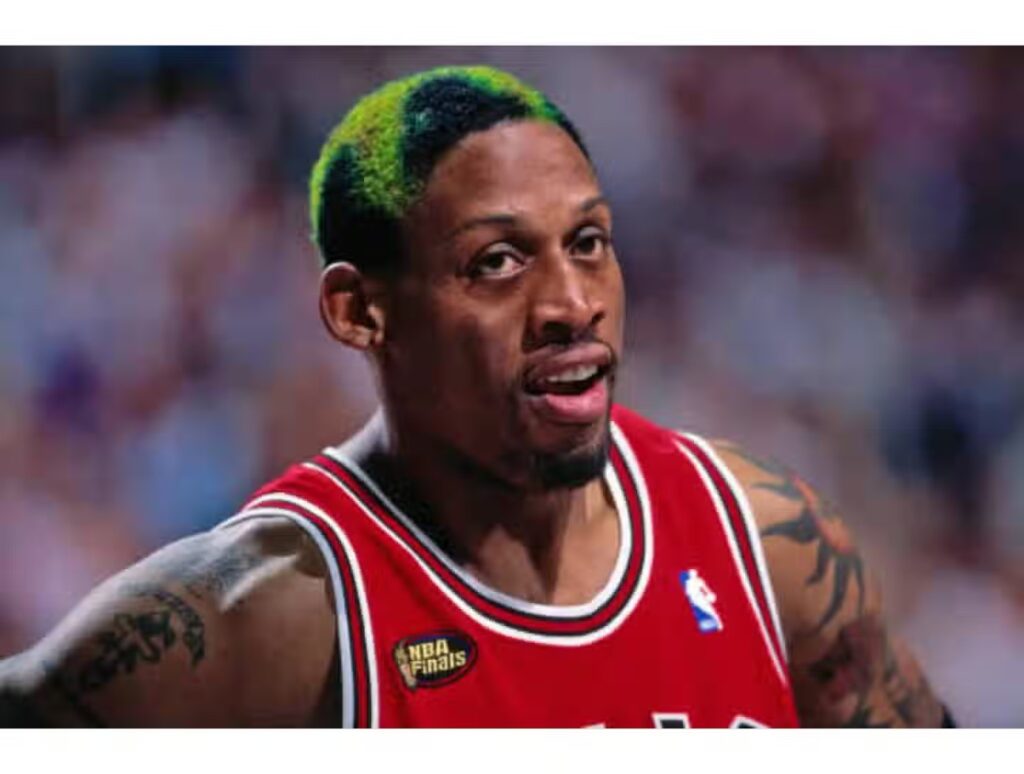
Rodman didn’t guard opponents; he consumed them. His defensive genius was rooted in psychological warfare as much as physicality. He studied his rivals’ body language, learning their habits and emotional triggers. When guarding superstars like Karl Malone or Scottie Pippen, he’d get into their heads with taunts, smirks, and unpredictable antics.
But beneath the chaos was strategy. Rodman was a master of footwork and angles, cutting off drives and forcing players into bad shots. His lateral quickness allowed him to switch onto guards, while his core strength let him battle centers. Few defenders in history could guard all five positions effectively, but Rodman did it night after night.
His defensive versatility became most evident during his stint with the Chicago Bulls, where his matchups often dictated the rhythm of entire games. Against elite scorers, Rodman used positioning and leverage to deny easy touches. Against big men, he used his low center of gravity to push them off balance. It wasn’t brute force—it was a form of basketball judo, redirecting energy rather than opposing it.
The Chicago Bulls Era: Chaos Meets Greatness
When the Bulls signed Rodman in 1995, it raised eyebrows. How could a volatile personality like Rodman fit into the disciplined world of Michael Jordan and Scottie Pippen? But coach Phil Jackson saw what others didn’t—beneath the noise, Rodman was a savant of the game.
The experiment worked. Rodman became the missing piece in the Bulls’ second three-peat from 1996 to 1998. While Jordan and Pippen handled scoring and leadership, Rodman anchored the defense and controlled the glass. His presence gave Chicago second chances and defensive stops that turned close games into wins.
During those years, his clashes with players like Karl Malone became legendary. Their duels weren’t just physical but theatrical—a battle of wills wrapped in raw emotion. Off the court, Rodman’s flamboyant persona drew headlines: dyed hair, piercings, tattoos, unpredictable behavior. But between the lines, he was all discipline. His preparation was meticulous, his understanding of team defense surgical.
The Bulls knew that if Rodman was focused, they had an unbeatable weapon. And despite the media circus, he delivered when it mattered most.
The Mind Behind the Mayhem
Understanding Rodman requires looking past the eccentricities. The colorful hair, wild nights, and tabloid stories were distractions to some—but to Rodman, they were outlets. Basketball was his sanctuary, the only place where chaos could be controlled and transformed into precision.
His emotional depth was both his strength and his struggle. On the court, he poured every ounce of himself into competition. Off the court, that intensity often found no outlet. Yet, that same emotional wiring made him extraordinary. He cared deeply about the craft of basketball, about doing the dirty work others avoided.
In a league that idolized scorers, Rodman found purpose in the overlooked. He didn’t crave spotlight; he craved perfection in his role. Few players have ever embraced selflessness so completely.
The Legacy of a Reluctant Superstar
Rodman’s career numbers—averaging just 7 points and 13 rebounds per game—don’t tell the full story. His true impact lies in how he changed the way defense and effort are valued in basketball. Before him, defense was often an afterthought. After him, it became a weapon.
He proved that a player could dominate a game without scoring, that rebounding could swing momentum like a clutch three-pointer. He elevated hustle into a form of leadership. Young players began to see value in energy, positioning, and selflessness.
Modern analytics now celebrate what Rodman did intuitively decades earlier—tracking deflections, contested rebounds, and switch coverage. In many ways, the NBA has caught up to the vision he lived out naturally.
Rodman’s influence stretches far beyond numbers. Players like Draymond Green and Marcus Smart embody his spirit today, blending defense, versatility, and emotional fire. Every time a team wins through grit instead of glamour, Rodman’s fingerprints are there.
More Than Just a Basketball Rebel
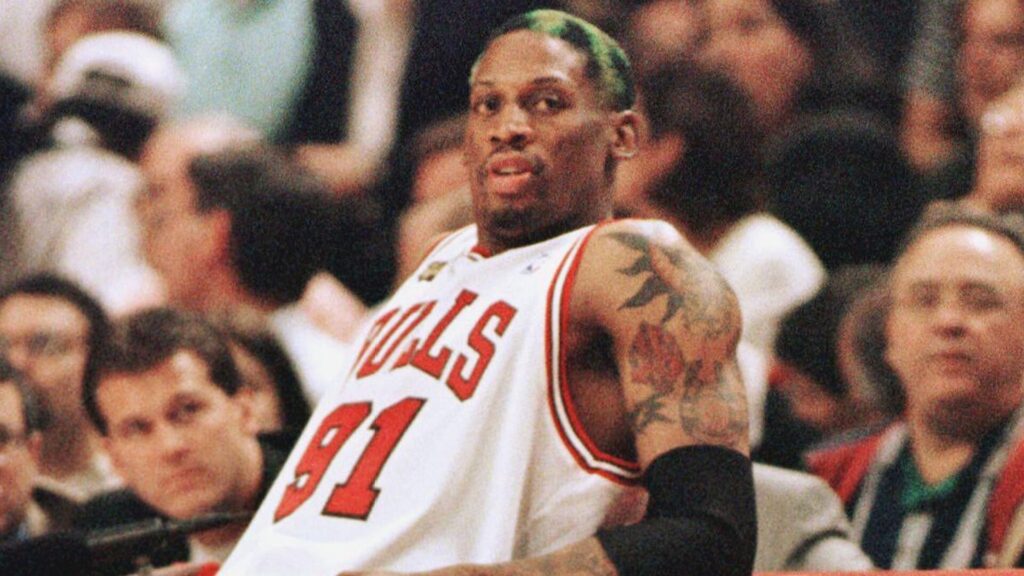
Outside the court, Rodman became a global enigma—an unexpected celebrity who blurred the lines between athlete and performer. Yet even as his fame took unpredictable turns, his basketball identity remained untouchable.
Ask his former teammates, and they’ll tell you the same thing: when the game began, Rodman was all business. He was the first to dive for a loose ball, the last to quit on a possession. He brought an energy that inspired everyone around him. His discipline during games contrasted sharply with his chaotic public image, but that contradiction only added to his mystique.
Rodman didn’t just play basketball; he embodied its essence—the relentless pursuit of something just beyond reach.
The Relentless Spirit Lives On
Time has softened the controversies and magnified the legacy. Today, Dennis Rodman stands as one of the most unique figures in sports history—a Hall of Famer who redefined what greatness can look like. His story reminds us that excellence doesn’t always come from scoring or glamour. Sometimes, it comes from sweat, instinct, and the refusal to quit.
Rodman’s name now echoes as a symbol of passion and perseverance. He made rebounding poetic and defense beautiful. In a game built on flash and finesse, he found meaning in the grind.
For those who understand the subtleties of basketball, Dennis Rodman wasn’t just a role player—he was an artist who painted masterpieces in motion, one rebound at a time.
