
 Terra Sanchez
Patrick Ewing and the Meaning of Greatness in New York
In the long, complicated history of the New York Knicks, few players have ever carried the weight of the franchise the way Patrick Ewing did. He was not merely a star center or a perennial All-Star; he became the emotional backbone of New York basketball for nearly two decades. In a city that demands toughness, resilience, and authenticity, Ewing embodied everything fans believed a Knick should be. His greatness was not defined by flash or controversy but by consistency, durability, and an unyielding competitive spirit that mirrored the city itself.
To understand Patrick Ewing’s legacy is to understand an era when the Knicks mattered deeply, when Madison Square Garden felt like the center of the basketball universe, and when every possession carried the intensity of a street fight. Ewing did not just play during that era. He defined it.

The Arrival of a Franchise Savior
When the Knicks selected Patrick Ewing with the first overall pick in the 1985 NBA Draft, expectations were immediate and overwhelming. The franchise had struggled for relevance, and New York was desperate for a hero. From the moment Ewing stepped onto the court, it was clear that he was built for the moment. His physical presence alone changed the geometry of the game. At seven feet tall with remarkable athleticism, Ewing combined size with agility in a way few centers had before.
His rookie season confirmed what many already believed. Ewing averaged over 20 points and nearly 10 rebounds per game, immediately transforming the Knicks into a playoff team. More importantly, he brought credibility back to the franchise. Madison Square Garden was loud again, not because of nostalgia, but because fans sensed that something real was being built around their new center.
Dominance Built on Skill and Strength
Patrick Ewing’s greatness often gets overshadowed by the dominant personalities of his era, but his skill set was extraordinary. He possessed a polished low-post game, a soft midrange jumper, and exceptional footwork for a player his size. Unlike many centers of the time, Ewing could face up, hit jump shots consistently, and punish defenders who gave him space.
Defensively, Ewing was the anchor every team dreams of. His shot-blocking instincts, timing, and willingness to challenge anyone at the rim made the paint a hostile environment for opponents. He wasn’t chasing highlight blocks; he was protecting territory. Night after night, guards thought twice before driving the lane, knowing Ewing was waiting.
What made him truly great was his durability. Through injuries, heavy minutes, and constant physical punishment, Ewing showed up. Seasons passed, rosters changed, coaches came and went, but Patrick Ewing remained the standard.
The Heart of the 1990s Knicks Identity
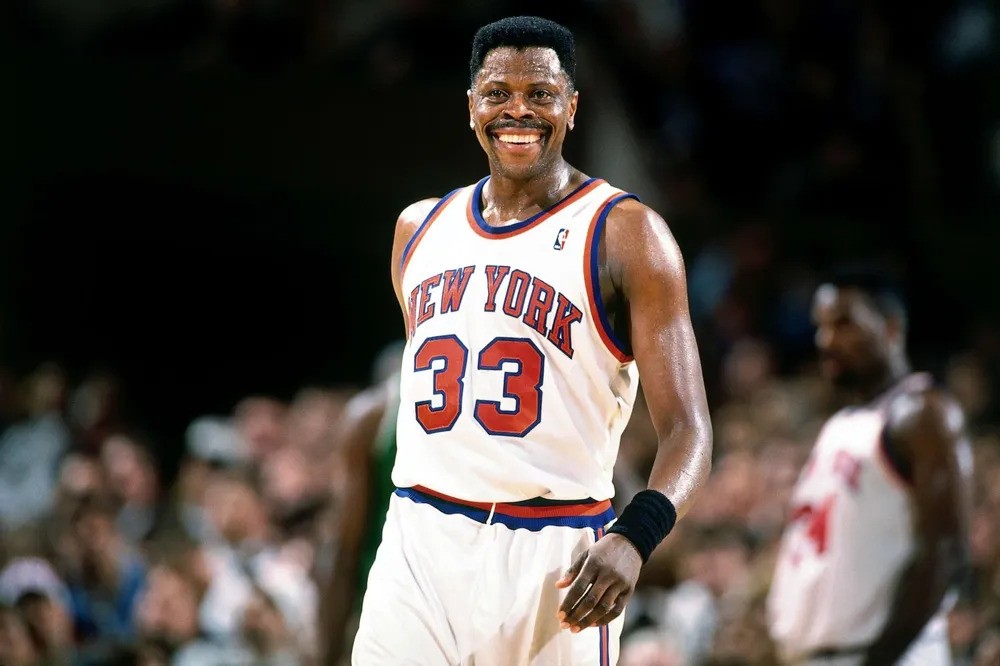
The 1990s Knicks were one of the most recognizable teams in NBA history, and their identity was inseparable from Ewing. Under coaches like Pat Riley and Jeff Van Gundy, the Knicks embraced a brand of basketball rooted in defense, physicality, and mental toughness. Ewing was the embodiment of that philosophy.
He wasn’t the loudest leader, but his presence commanded respect. Teammates followed his work ethic. Opponents respected his toughness. Fans trusted him to fight every night, even when the odds felt stacked against New York. Those Knicks teams didn’t rely on finesse or highlight reels. They relied on Ewing setting the tone, battling elite centers, absorbing contact, and still finding ways to produce.
Madison Square Garden became a fortress during that era, and Ewing was its guardian. Every rebound, every block, and every hard-earned basket reinforced the belief that the Knicks would not be pushed around.
Rivalries That Defined a Generation
Patrick Ewing’s greatness becomes even clearer when viewed through the rivalries that shaped his career. He went head-to-head with some of the best centers the game has ever seen, including Hakeem Olajuwon, David Robinson, Shaquille O’Neal, and Alonzo Mourning. These matchups weren’t just games; they were battles of pride, skill, and endurance.
Ewing never backed down. Against Olajuwon’s finesse, Robinson’s athleticism, or Shaq’s brute force, Ewing held his ground. He competed on both ends, understanding that his role went beyond statistics. His responsibility was to give New York a chance every night, regardless of who stood across from him.
The Knicks’ playoff wars with teams like the Chicago Bulls, Indiana Pacers, and Miami Heat further cemented Ewing’s legacy. These series were physical, emotional, and often brutal. Ewing absorbed criticism, pressure, and disappointment, yet he continued to lead. Greatness is not about avoiding adversity, and no player embodied that truth more fully than Patrick Ewing.
A Superstar Without Shortcuts
One of the most remarkable aspects of Ewing’s career was how little he relied on shortcuts. He wasn’t chasing endorsements or shaping his image for national appeal. He focused on basketball, improvement, and responsibility. In a market as intense as New York, that quiet professionalism stood out.
Ewing’s loyalty to the Knicks is often overlooked in an era where stars frequently change teams. Year after year, he committed to the franchise, believing that success would come through perseverance. Even as criticism mounted during playoff failures, he never distanced himself from the city or the fans. He absorbed the disappointment personally, carrying it as motivation rather than resentment.
That willingness to shoulder blame, to stand at the center of both success and failure, is part of what makes him a great basketball player in the deepest sense of the word.
Measuring Greatness Beyond Championships
The absence of an NBA championship has unfairly shaped conversations around Patrick Ewing’s career. While championships matter, they do not tell the full story of individual greatness. Basketball is a team sport influenced by timing, health, and circumstance. Ewing played during an era dominated by dynasties, most notably Michael Jordan’s Bulls, which blocked countless great players from reaching the summit.
What cannot be denied is Ewing’s consistency at an elite level. He finished his career with over 24,000 points, nearly 12,000 rebounds, and close to 3,000 blocks. He was an eleven-time All-Star and a perennial All-NBA selection. These numbers are not products of luck or hype. They are the result of sustained excellence over fifteen seasons.
Greatness is also measured by impact. The Knicks were relevant because of Patrick Ewing. They were feared because of Patrick Ewing. For an entire generation, New York basketball meant watching number 33 battle in the paint.
The Emotional Bond With New York
Patrick Ewing’s relationship with New York was complex, passionate, and deeply human. Fans demanded everything from him, and he gave them everything he had. There were moments of frustration and criticism, but there was also loyalty and pride. Ewing represented effort, accountability, and resilience, values that resonate deeply in the city.
When he finally left the Knicks late in his career, it felt like the end of something larger than basketball. An era closed. Madison Square Garden no longer had its anchor. The team struggled to find an identity, and fans realized how rare it was to have a player who could carry both expectations and culture for so long.
Ewing didn’t just play in New York. He belonged to it.
Legacy of a Defining Center
Patrick Ewing’s place in basketball history is secure, not because of rings, but because of influence. He helped define what a franchise center could be, combining skill, toughness, and leadership in a way that inspired teammates and intimidated opponents. His impact stretched beyond box scores into the emotional fabric of the game.
For Knicks fans, Ewing remains the standard by which all others are measured. For basketball purists, he stands as proof that greatness is about commitment, resilience, and excellence sustained over time. He didn’t chase moments. He built a legacy possession by possession.
In the end, Patrick Ewing was more than a great center. He was the soul of an era, and New York basketball will forever carry his imprint.