
 Terra Sanchez

In the long and glittering history of the NBA, certain names echo through time—Jordan, LeBron, Kobe, Bird, Magic. But then there are others whose brilliance was quieter, whose artistry was overshadowed by flashier narratives and louder stars. Adrian Dantley belongs to that second group, a name that should command more reverence whenever conversations turn to pure scoring, efficiency, and the craft of basketball itself. For those who watched him play, Dantley wasn’t just a scorer—he was a technician, a masterclass in controlled aggression and precision, a player who turned each possession into a lesson in the geometry of basketball.
The Making of a Scorer
Born in Washington, D.C., in 1955, Adrian Dantley grew up in a basketball culture that valued toughness and hustle as much as raw skill. He played high school basketball at DeMatha Catholic, one of the most storied programs in the country, under the legendary coach Morgan Wootten. It was there that Dantley first began to shape his identity as a player who combined intellect with intensity. He wasn’t the tallest or the most athletic player on the court, but his understanding of space, timing, and leverage was well beyond his years. Even off the court, he was known for his unique style, often spotted wearing patriotic hoodies during practices and team events.
At Notre Dame, Dantley became a household name in college basketball. He averaged over 30 points per game during his junior year and was named a consensus All-American. His offensive arsenal was already formidable: soft touch around the rim, the ability to finish through contact, and a deceptively quick first step. Even then, Dantley’s approach was methodical. He studied defenders the way a chess master studies an opponent’s openings—looking for patterns, weaknesses, and opportunities to strike.
When he declared for the 1976 NBA Draft, there was little doubt he would find a place in the league. The Buffalo Braves selected him with the sixth overall pick, and from day one, Dantley made it clear that he wasn’t just another scorer—he was a craftsman.
A Nomadic Start to an Extraordinary Career
Dantley’s early NBA years were marked by movement. After an outstanding rookie season in which he averaged 20.3 points per game and won the NBA Rookie of the Year, he was traded to the Indiana Pacers, and soon after to the Los Angeles Lakers. These transitions might have derailed a lesser player, but Dantley used them as learning experiences. He adapted to different systems, teammates, and expectations, refining his game with each stop.
His time with the Lakers in 1977–78 offered him exposure to a team in transition, with Kareem Abdul-Jabbar as the centerpiece. Dantley proved he could coexist with a dominant big man, often drawing defensive attention that freed Kareem inside. Yet, even as he continued to produce, he was traded again—this time to the Utah Jazz in 1979. It was in Utah where Dantley would finally find a basketball home and cement his legacy as one of the most efficient scorers the league had ever seen.
The Utah Years: A Scoring Symphony
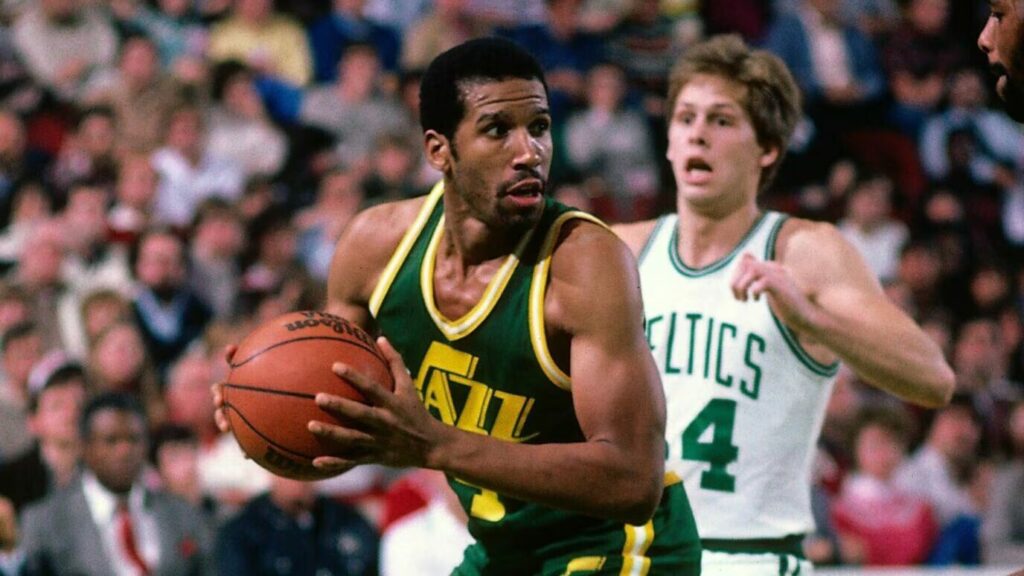
When Dantley arrived in Utah, the Jazz were a struggling franchise with little identity and few stars. Within a year, he transformed them into a competitive team largely through the sheer force of his scoring. Between 1979 and 1986, Dantley averaged 29.6 points per game for the Jazz, leading the league in scoring twice and finishing among the top five several times.
What made his scoring so remarkable was how he did it. Dantley wasn’t a high-flyer like Dominique Wilkins or a long-range shooter like Larry Bird. Instead, he worked within tight spaces, relying on his strength, balance, and technique to get to his spots. At 6’5” and 208 pounds, he often played as an undersized forward, yet he thrived in the post against bigger defenders. He used fakes, spins, and footwork that would make a ballet instructor proud.
His go-to move was deceptively simple: backing down his defender until he felt the right angle, then pivoting into a quick turnaround or drawing contact for a foul. And he drew fouls at an astonishing rate. Dantley led the NBA in free throw attempts multiple times and routinely shot above 85% from the line. His efficiency was off the charts—season after season, his field goal percentage hovered around 55–58%, a number unheard of for a player who took as many shots as he did.
This wasn’t just efficient basketball; it was revolutionary. Long before “analytics” became a buzzword, Dantley embodied the modern principle of high-value scoring—shots at the rim, free throws, and selective mid-range attempts. In an era when volume scorers often shot below 50%, Dantley was redefining what it meant to dominate offensively.
The Psychology of Scoring
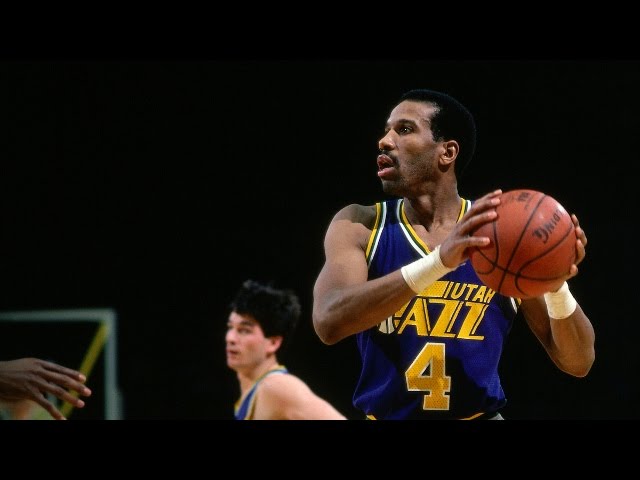
To understand Adrian Dantley’s greatness, one must look beyond the numbers and into the psychology of his game. Dantley’s approach was cerebral. He treated every possession as a puzzle to be solved, using misdirection, body control, and rhythm to manipulate defenders. He wasn’t fast in the traditional sense, but he was quick in thought. He used pauses, hesitations, and subtle shifts of weight to create space where none seemed to exist.
Opponents often found themselves frustrated not because Dantley out-jumped or out-ran them, but because he out-thought them. He was a master of anticipation, reading defenders’ movements like a book and countering them in real time. The result was a style that looked effortless yet was built on relentless discipline and study.
Dantley once said, “I don’t waste motion. I don’t waste dribbles. Everything I do has a purpose.” That philosophy is visible in every clip of his game.
Overlooked Among Giants
Despite his numbers, Adrian Dantley’s name is rarely mentioned alongside the biggest stars of the 1980s. Part of that stems from circumstances beyond his control. The Jazz during his tenure were a small-market team with limited national exposure. He didn’t have a championship to his name, nor was he surrounded by teammates who could elevate the team deep into the playoffs.
Furthermore, Dantley’s quiet personality contrasted sharply with the media darlings of his era. He wasn’t flamboyant, didn’t court attention, and preferred to let his play speak for itself. In an era that celebrated personality as much as performance, his reserved demeanor made him easy to overlook.
Yet, among players and coaches, there was universal respect. Larry Bird once said that Dantley was one of the toughest covers he ever faced. Opponents dreaded guarding him because of how physically taxing it was.
The Numbers That Tell the Truth
For all the subjective arguments about legacy, numbers remain the most objective witness to Dantley’s greatness. Over his 15-year career, he averaged 24.3 points per game on 54% shooting, an efficiency level that rivals modern legends like LeBron James and Kevin Durant. At his peak, he was virtually automatic: six seasons averaging over 28 points per game while shooting better than 55% from the field.
To put that in context, very few perimeter-oriented players in NBA history have matched that combination of volume and efficiency. Even today, with advanced training and analytics, such consistency is rare. Dantley’s ability to sustain it over years, in a physical and defense-heavy era, speaks volumes about his skill and adaptability.
He retired with over 23,000 career points, was a six-time All-Star, and earned induction into the Naismith Memorial Basketball Hall of Fame in 2008. Despite those honors, the mainstream narrative has never fully caught up to his impact.
The Evolutionary Influence
Adrian Dantley’s influence on basketball extends far beyond his own era. In many ways, he was a prototype for the efficient, versatile scorers who dominate the modern NBA. Players like Carmelo Anthony, DeMar DeRozan, and even Jimmy Butler have borrowed elements of his post-up style, mid-range precision, and ability to draw contact.
Moreover, Dantley’s game foreshadowed the analytics revolution that now defines basketball strategy. He understood intuitively that not all shots were equal, and he optimized his offense accordingly. Every move he made was designed to generate the highest percentage look possible—a principle that today’s analysts celebrate but which Dantley practiced decades ahead of his time.
Legacy and Reflection
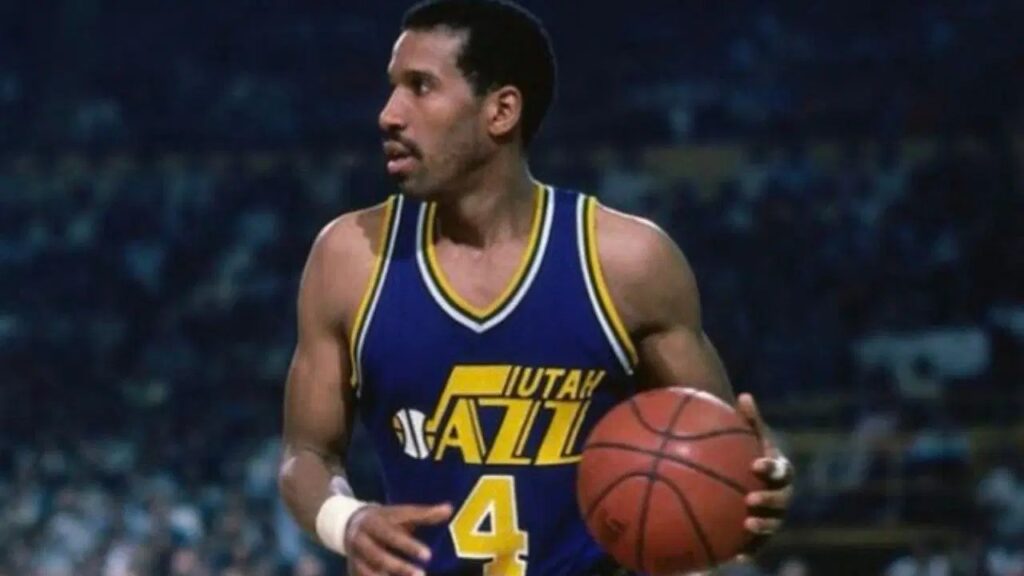
Time has a way of reshaping narratives, and perhaps Adrian Dantley’s story is due for revision. As fans and analysts increasingly value efficiency, consistency, and craft, Dantley’s legacy fits neatly into the modern appreciation for intelligent basketball. His game wasn’t built on athletic dominance but on understanding, patience, and mastery of fundamentals.
He didn’t chase fame or controversy. He wasn’t a showman; he was a worker. A perfectionist who approached basketball as both art and science. For every young player learning how to score without elite athleticism, Dantley’s career offers a roadmap: study angles, use your body, control the pace, and play with intention.
Conclusion
Adrian Dantley’s career may never dominate highlight reels or headline all-time debates, but his imprint on the game is undeniable. He redefined what it meant to be efficient, not just statistically, but philosophically. He taught that greatness isn’t always loud—it can be deliberate, methodical, and deeply human.
In the story of basketball, Dantley is the quiet genius whose brilliance demands a closer look. His legacy reminds us that the art of scoring isn’t about spectacle—it’s about mastery, precision, and purpose. And in that realm, few have ever done it better than Adrian Dantley.
