
 Terra Sanchez
There are players whose legacies are sculpted not just by championships or statistical milestones, but by the way they moved through the game. Clyde “The Glide” Drexler belongs unmistakably to that category. Even among the greats of his era, Drexler occupied his own stylistic lane, blending explosiveness with a smoothness that made his athletic feats look effortless. His career was defined by flight, fluidity, and an uncanny ability to elevate both literally and metaphorically. To understand Drexler is to understand basketball through a more poetic lens, where technical mastery meets instinctive improvisation and grace becomes a competitive weapon.
The Art of Flight
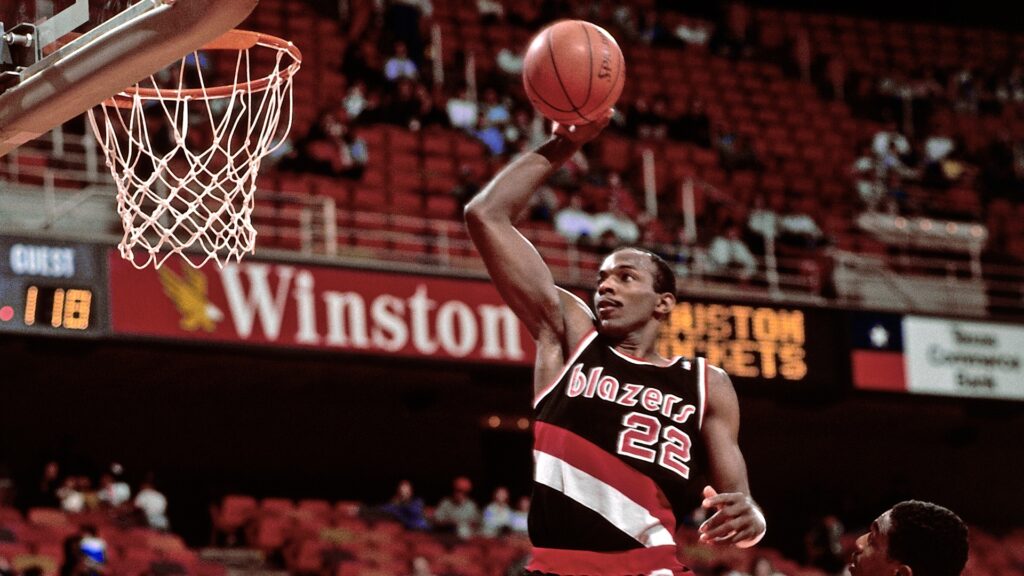
What separated Drexler from so many of his contemporaries was not just that he could soar, but that he seemed uniquely at home in the air. His ability to take off from awkward angles or with minimal runway made him a threat anytime he had a sliver of space. His dunks became something of a personal trademark, not for their violence but for their elegance. When other players exploded toward the rim, Drexler glided, arms stretching long and body tilting into a kind of aerodynamic sculpture. The nickname wasn’t just a marketing flourish; it was a direct reflection of how he played.
This aerial finesse wasn’t simply aesthetic. It allowed Drexler to manipulate defenders in a way few players could. He would rise early to freeze them, or hang in the air long enough for them to commit to the wrong direction. His layups often came after he seemed to pause mid-flight, changing the ball from one hand to another with a fluidity that felt almost balletic. The ability to delay a release or shift his body mid-air made his drives unpredictable and nearly impossible to contest cleanly. Opponents often said guarding him felt like trying to trap smoke.
A Relentless Transition Force
One of Drexler’s most defining qualities was his dominance in transition. Few players in NBA history could take a defensive rebound or outlet pass and turn it into an instant scoring opportunity with such consistency. He moved like a sprinter who never appeared to be sprinting, legs eating up space with long, effortless strides. When Drexler accelerated into the open floor, the defense became something secondary, almost decorative, trailing behind him as though watching the conclusion of a play they already knew the ending to.
What made Drexler so exceptional in transition was his ability to read the court instinctively. He had a talent for anticipating where defenders would rotate, where teammates might appear, and where angles would open. His full-court attacks weren’t rushed or chaotic—they felt controlled, choreographed in real time. He could finish with a soaring dunk, a feathery layup, or a precision pass, depending entirely on what the moment demanded. His decision-making on the break made Portland’s fast-paced offense hum, and later provided Houston with a weapon that gave them a new dimension during their championship run.
The Power of Versatility
Even while Drexler’s aerial artistry earned the most attention, his game was far more complete than the highlights suggested. He was one of the most versatile guards of his era, a player who could score, rebound, distribute, and defend with equal commitment. Long before the term “positionless basketball” entered the conversation, Drexler embodied the spirit of it. His teams didn’t need him to occupy a rigid role; they needed him to be everywhere, and he had the skill set to make that possible.
His rebounding was especially remarkable. Drexler consistently pulled down numbers that guards rarely touched, and he did so not simply by outjumping players but by anticipating the arc of the ball. He had a natural sense for where rebounds would land, allowing him to slip into gaps and secure possession before taller players could react. This gave his teams second chances and fueled the transition attacks he thrived in.
His playmaking also stood out. Drexler was not a point guard by title, but he often played like one in spirit. His passes were intuitive, delivered with timing that suggested a deep understanding of offensive rhythm. Whether he was hitting a cutter with a bounce pass, feeding a shooter on the wing, or finding a big man in traffic, Drexler’s vision elevated the players around him. He saw the game holistically, and that broadened his influence on every possession.

The Signature Moves That Defined “The Glide”
While Drexler’s game was filled with moments of improvisation, several moves became synonymous with his style. The most iconic was his sweeping, one-handed tomahawk dunk delivered on the fast break. As he approached the basket, the ball seemed to float back behind him, arm stretching to its full capacity. Then, with a smooth whipping motion, he brought it down through the rim with authority that belied the elegance of the approach. Fans came to expect it, yet they never tired of it. Even defenders knew the signature was coming, and still had little answer for it.
Another defining move was his baseline drive. Starting from the corner or near the wing, Drexler would jab step, lower his shoulder slightly, and then launch into a long, gliding stride that took him past the defender before they could react. Once he turned the corner, the outcome felt inevitable. He often finished with a reverse layup, using the rim as protection, sometimes switching hands mid-air to avoid a contest. His reverses were not hurried or contorted—they were smooth, assured, and practiced with a painter’s touch.
He also had a deceptively effective mid-range jumper. While it may not have been as celebrated as his aerial exploits, it was a crucial part of his arsenal. Drexler used a high release and soft touch, often pulling up out of a drive to keep defenders guessing. The jumper wasn’t his preferred weapon, but it was one he refined over time, becoming especially important in playoff battles when defenses walled off the paint.
Defense Through Anticipation and Effort
Drexler’s defense often flew under the radar, overshadowed by his scoring and highlight plays. Yet he was consistently among the league leaders in steals, a testament not only to quick hands but to sharp instincts. He excelled at reading passing lanes, jumping them with perfect timing to ignite fast breaks. His steals often felt like momentum-shifting plays—not just takeaways but immediate scoring opportunities.
On the ball, Drexler used his length and lateral quickness to bother scorers. While he wasn’t the type of defender who bullied opponents physically, he harassed them with movement and intelligence. He rarely bit on fakes, and he understood how to funnel players into less dangerous spaces. His defensive contributions were steady, disciplined, and anchored in the same smooth athleticism that defined his offense.
A Style That Influenced a Generation
Clyde Drexler’s impact on basketball extended beyond statistics or even team success. His style became part of the sport’s cultural identity during the 1980s and 90s. He helped define an era in which athleticism merged with artistry, where players were expected not only to score but to do so with charisma. Young players watched Drexler and learned that power did not need to look violent, that elegance could dominate just as decisively as force.
Many wings who came after him—players who blended size, skill, and athleticism—owed a quiet debt to the template Drexler helped establish. He proved that a guard could rebound like a forward, pass like a point guard, and finish like a center. He showed how a player could be both the engine of a team and its emotional steady hand.
The Legacy of a Timeless Game
When evaluating Drexler today, what stands out most is the timelessness of his style. The modern NBA is filled with long, fluid athletes who can feast in transition, handle the ball, and attack the rim from multiple angles. In many ways, the league evolved toward the type of player Drexler naturally was. His skill set feels as relevant now as it did during his prime, a testament to how ahead of his time he truly played.
The smoothness, the control, the aerial grace—these elements combine to create a legacy rooted in both substance and beauty. Drexler didn’t just play basketball; he elevated it. He brought a sense of poetry to the hardwood, a reminder that athletic dominance can also be aesthetically stunning. His career is a celebration of fluid motion and creative expression, a fusion that remains rare even among the sport’s greatest talents.
Clyde “The Glide” Drexler remains one of the purest examples of how style can shape legacy. His signature moves, his fluid movement, and his multidimensional impact on the game continue to resonate. Watching old footage of him feels not like revisiting history, but like witnessing a player whose game would thrive in any era. That is the true mark of greatness: a game that transcends time, carried on wings that seemed to lift the sport itself.
