
 Terra Sanchez

Every era in basketball carries a handful of players who don’t just dominate the game—they bend it, reshape it, and leave behind a blueprint that future generations quietly imitate. Tracy McGrady belongs to that rare group. His rise from a lanky high-school phenom to one of the most feared scorers in NBA history wasn’t simply the story of a great athlete fulfilling his potential. It was the unfolding of a new model for perimeter basketball, one built on smoothness, creativity, and an almost artistic control of space. To understand how modern scorers operate—how they use angles, pace, and unpredictability—you only need to revisit McGrady at his peak.
Early Talent That Foreshadowed a New Style
Before Tracy McGrady even entered the NBA, his game hinted at something unorthodox. He didn’t play like a traditional wing. Instead of relying on brute force or rigid structure, he moved with an ease that felt almost improvised. His handle was unusually fluid for a player his size. His jumper, though still developing in his teenage years, carried that distinctive high release that would later become one of the most unguardable shots in basketball. More than anything, he had an innate sense of rhythm—an instinct for how to lull defenders, shift gears, and strike without warning.
When he entered the league straight out of Mount Zion Christian Academy, his talent was raw but unmistakable. The NBA in the late 1990s was transitioning from the physical, hand-check-heavy era to something more open. McGrady arrived right at that threshold, and he possessed tools that fit perfectly with the evolution about to unfold. Though his early years in Toronto positioned him mostly as an athletic defender and slashing role player, those flashes of creative scoring were impossible to miss. He was already experimenting with the mid-post fadeaway, the hang dribble, the smooth pull-up three. It was clear he wasn’t meant to be just another supporting star.
Orlando and the Birth of an Offensive Force
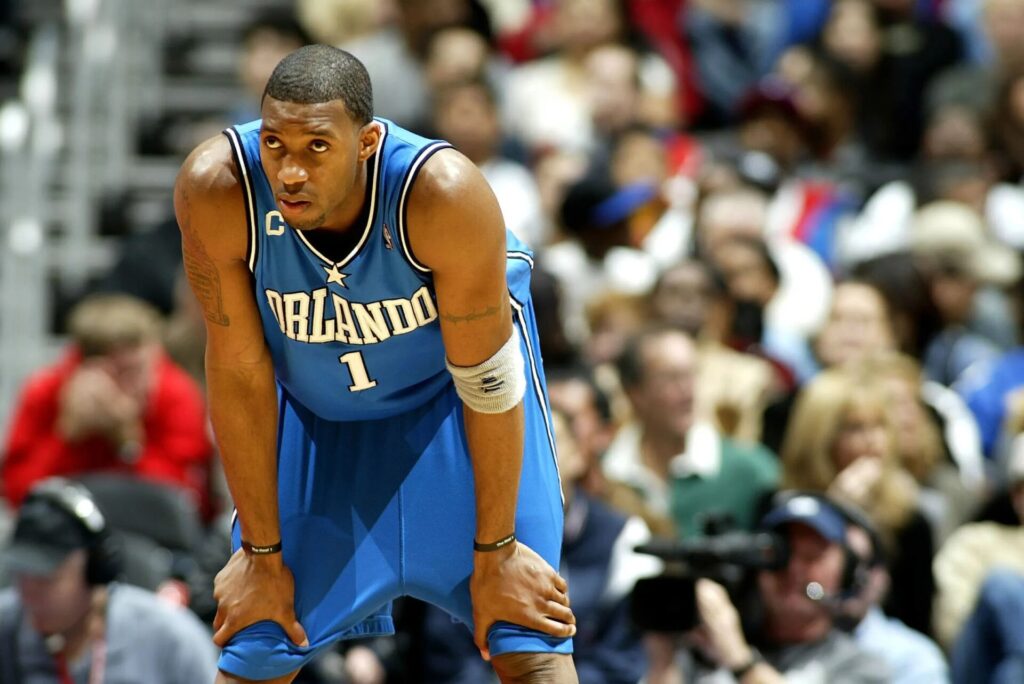
Everything changed when McGrady signed with the Orlando Magic. Suddenly he wasn’t just a player with potential—he was the centerpiece. This shift in responsibility catalyzed one of the most dramatic ascents in NBA scoring history. What emerged was a perimeter scorer unlike anything the league had seen. He wasn’t a guard trapped in a forward’s body or a forward trying to mimic a guard. He was a hybrid, and that hybridity threatened defenses in ways they had no blueprint for.
In Orlando, the game slowed down for him. He mastered the art of shot creation from every level of the floor. His step-back jumper became a signature. His ability to snake around screens, pause, and rise for a jumper with a defender still recovering became routine. For a player standing 6-foot-8 with a wingspan that seemed to stretch toward the rafters, this level of finesse was astonishing. But what truly set him apart was how naturally he melded all these tools together. He didn’t look mechanical. He didn’t rely on force. He played like scoring was a language he spoke fluently, without needing to think.
Defenders weren’t equipped for him. Put a big on him, and he would take them off the dribble. Assign a smaller, quicker guard, and he would shoot right over the top or bury them in mid-post footwork. He wasn’t just versatile; he was unpredictable. The league had seen tall scorers and dynamic wings, but McGrady’s combination of spatial awareness, ball handling, and effortless elevation foreshadowed the direction perimeter basketball would eventually travel.
Redefining What a Scoring Wing Could Be
One of the most overlooked elements of McGrady’s influence is how he reframed the role of a franchise wing. Before him, elite perimeter scorers usually fit clearer archetypes: the relentless attackers, the physical punishers, the specialized sharpshooters. McGrady didn’t fit any of them. Instead, he introduced a new prototype: the tall, silky scorer who could function as both offensive initiator and isolation creator.
This wasn’t just about skill—it was about mentality. McGrady played like a guard trapped in a forward’s frame, yet he never relied on brute strength to dominate. His game emphasized timing, balance, and control. He could manipulate defenders with a glance or a subtle shift of his hips. He normalized the idea of a primary scorer who didn’t need to bulldoze their way to the basket or operate from strict play-calling frameworks. He gave freedom a shape, and future stars took notice.
It’s no coincidence that so many of today’s elite wings—those who live in the midrange, glide into jumpers, or use pace changes more than raw speed—mirror elements of McGrady’s game. From Kevin Durant’s smooth pull-ups to Paul George’s rhythmic footwork to Jayson Tatum’s blend of length and finesse, T-Mac’s fingerprints are everywhere. What they do today with advanced spacing and modern coaching infrastructures echoes what McGrady was doing against packed defenses and hand-check rules two decades earlier.

The Houston Years and a Matured Offensive Mind
When McGrady arrived in Houston, his game took on a different shape. While still an elite scorer, he grew more comfortable orchestrating the offense. His passing, always underrated, became a defining part of his identity. He understood how to manipulate attention—how to draw defenders into his gravity and create open looks for teammates. He wasn’t merely a bucket-getter; he was a full offensive engine.
In many ways, this version of McGrady emphasized the cerebral qualities that would inspire later generations. His patience in the pick-and-roll, his ability to deliver cross-court passes from tight windows, and his sense for when to accelerate or decelerate became hallmarks of his style. He was no longer just redefining perimeter scoring—he was shaping how star wings could function as offensive hubs.
Even in Houston, where injuries began casting a shadow over his prime, McGrady’s brilliance remained luminous. The 13 points in 33 seconds, perhaps the most iconic burst of clutch scoring in NBA history, distilled everything that made him transcendent. That moment wasn’t just about shot-making; it was about audacity, composure, and a scorer’s intuition honed through years of mastering pace and angles. What he accomplished in that half-minute felt supernatural, but it was actually the culmination of a lifetime of developing a scoring rhythm that defied defensive scheme.
Legacy in the Modern NBA
Scoring in today’s NBA is different because of players like Tracy McGrady. When you watch a modern scorer step back from 28 feet, glide into a midrange jumper, or use pace as a weapon instead of brute force, you’re seeing reflections of his influence. He played before spacing fully blossomed, before rule changes helped offensive perimeter players flourish, and before analytics reshaped shot selection. Yet he thrived in ways that align more with today’s game than the one he actually played in.
What makes his legacy even more remarkable is that he did all this with an aesthetic that felt entirely his own. The effortless elevation. The smooth dribble pull-up. The way he could create separation using nothing more than a rhythmic sway of his shoulders. His style wasn’t about outmuscling defenders—it was about outthinking and outmaneuvering them. And in that sense, he offered a preview of how scoring would evolve.
Today’s NBA is dominated by players who blend size, skill, and creativity. They operate from every level of the floor. They use the dribble to dictate tempo. They thrive in one-on-one situations but also serve as facilitators. McGrady wasn’t simply ahead of his time—he was partially responsible for the time that followed.
The Human Story Behind the Innovation
It’s impossible to talk about McGrady’s evolution without acknowledging the emotional undertones of his career. For all his skill and influence, he battled injuries that stole chunks of his prime. He faced the frustration of carrying teams that struggled to break through in the postseason. He dealt with the pressure of superstardom without the luxury of long-term team stability. And still, through all of it, he crafted a style of play that resonated with millions.
Part of what made him unforgettable wasn’t just the brilliance of his scoring—it was the humanity behind it. He looked effortless, but those who followed his story knew the hours he spent refining every motion. He made difficult shots look easy, yet he often spoke with humility and introspection. His game was built on grace, but his career was shaped by resilience.
A Blueprint That Lives On
Tracy McGrady’s evolution reflects the evolution of basketball itself. He bridged eras, connecting the isolation-heavy, physical style of the early 2000s with the open-floor creativity that defines today’s game. He didn’t need to win championships to influence future generations. His impact lives in the way modern scorers approach the game, the variety of skills they prioritize, and the fluidity with which they attack from every area of the court.
To watch T-Mac in his prime is to watch the modern NBA taking its first breath. He redefined what was possible for a perimeter scorer, not through overwhelming dominance but through innovation, instinct, and artistry. His evolution wasn’t just the journey of a great player—it was the emergence of a new scoring philosophy. And that legacy will always endure.
